
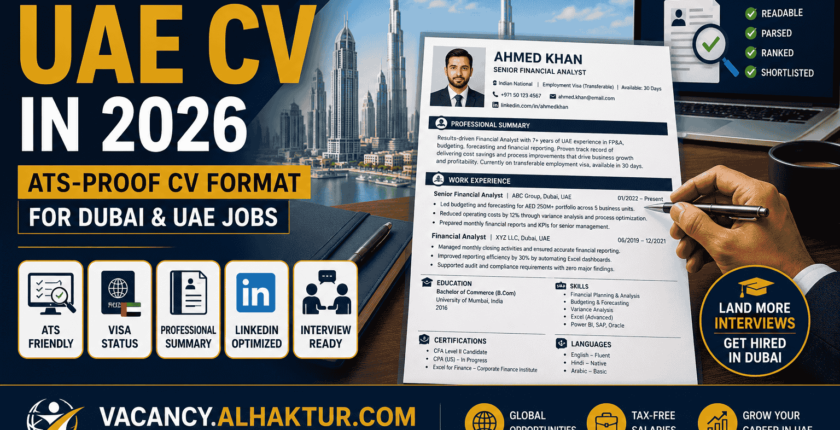
How to Write a UAE CV in 2026: ATS Format, Section Order & Examples
| Quick Answer: A UAE CV in 2026 should be 2–3 pages, single-column, reverse-chronological format, saved as PDF. Include nationality, visa status, and availability in the header. A professional photo is expected for customer-facing roles. Use keywords from the job description to pass ATS systems like Workday and Taleo used by most large UAE employers. |
Most CVs arriving in Dubai recruiter inboxes were written for a different market — the UK, India, the US, or the Philippines — and were never reformatted for the UAE hiring system. The result is a CV that looks polished but performs poorly.
The fix is structural, not cosmetic. A UAE CV in 2026 is built around three things: ATS portal compatibility, Dubai recruiter scan patterns, and UAE-specific availability signals. This guide covers all three.
UAE CV vs Western Resume: Key Differences
Before writing, understand what makes a UAE CV different from what you may have used elsewhere:
| Element | UAE CV | US / UK Resume |
| Length | 2–3 pages | 1 page (US) / 2 (UK) |
| Photo | Expected (customer-facing) | Not included |
| Nationality | Required | Not included |
| Visa status | Required in header | Not applicable |
| Age / DOB | Standard to include | Not included |
| Salary | Current + expected | Often omitted |
| Format | Reverse chronological | Various |
| File type | PDF always | PDF or Word |
The Four UAE Hiring Systems — and What Each Expects
Dubai’s hiring market is not a single system. It is four parallel systems with overlapping but distinct CV expectations:
- Multinational corporations (banks, tech firms, FMCG): Use ATS like Workday, SAP SuccessFactors, or Oracle Taleo. Single-column, keyword-dense CV is essential.
- Semi-government entities (ADNOC, RTA, Etisalat): Structured application portals with specific form fields. Your CV supplements the form — keep it consistent with what you enter online.
- Free zone companies (DIFC, Dubai Internet City): More Western in culture — CV expectations closer to international standards, but UAE header info (visa status, availability) still expected.
- SMEs and local companies: Often hire based on referrals and direct CV submissions. Biodata-style formats are rejected — always use a professional reverse-chronological CV.
Critical point: Two-column ‘modern’ CV templates designed for visual appeal break field extraction on Workday and Taleo. A visually plain CV that parses correctly will always outperform a beautiful CV that the ATS cannot read.
UAE CV Section Order — 2026 Standard
1. Header (The Most Important Section)
Your name large and bold at the top — not the words ‘Curriculum Vitae’. Below your name on one line:
- Full name (exactly as in passport — inconsistencies cause issues at visa stage)
- Target job title (match the exact wording from the job posting)
- Location: Dubai, UAE (or city you are based in / willing to relocate to)
- Nationality
- Visa status: e.g. ‘Employment Visa — transferable’ / ‘Visit Visa’ / ‘Cancelled Visa — immediate joiner’
- Availability: ‘Immediate’ / ’30 days notice’ / specific date
- UAE mobile number (with +971 code)
- Professional email
- LinkedIn profile URL
Example header line: Indian National | Employment Visa (Transferable) | Available: 30 days | +971 50 XXX XXXX | name@email.com | linkedin.com/in/yourname
2. Professional Summary (3–4 Lines)
This is the single most-read section of your CV. Write it last. It must contain:
- Your job title and years of UAE or relevant experience
- Your key technical specialisation or industry sector
- One quantified achievement with a number
- Your visa status and availability (reinforces the header)
Strong example: ‘Results-driven Civil Engineer with 8 years of UAE construction experience delivering high-rise and infrastructure projects. Managed 3 contracts worth AED 120M collectively, all completed on time and within budget. Currently on transferable employment visa, available in 30 days.’
Weak example: ‘Hardworking and dedicated professional seeking a challenging position where I can utilise my skills.’ — This tells a Dubai recruiter nothing.
3. Work Experience
Reverse chronological — most recent role first. For each role:
- Company name, job title, location (city, UAE or country), dates (MM/YYYY to MM/YYYY or Present)
- 3–5 bullet points per role starting with strong action verbs
- At least 2 quantified achievements per role
Strong bullet formula: Action verb + what you did + result + number
Example: ‘Reduced month-end closing time by 2 days by redesigning the reconciliation workflow, saving 18% in overtime costs annually.’
Dubai recruiters concentrate on practical, quantifiable accomplishments — not job descriptions. Every role should show what improved, grew, saved, or was built as a result of your work.
4. Education
Degree title, university name, country, graduation year. If your degree is not yet attested, add: ‘(MOHRE attestation in progress)’. UAE employers understand this process. Include GPA if above 3.0 or equivalent.
5. Skills
Organise into two clear categories for ATS and human readability:
- Hard skills: specific software, tools, technical certifications (SAP, AutoCAD, Python, CISSP, PMP, CPA, etc.)
- Languages: Arabic, English, Hindi, Tagalog, French — state proficiency level for each (Native / Fluent / Conversational / Basic)
ATS tip: Hard skills should appear as a simple comma-separated list or single-column bullet list — never as graphical rating bars or visual icons. ATS systems cannot read graphical elements.
6. Certifications & Professional Memberships
List with issuing body and year: PMP (PMI, 2023), UAE Driving Licence (Dubai RTA, 2022), DHA Licence (Dubai Health Authority, 2024), IELTS 7.5 (British Council, 2023), etc.
ATS Formatting Rules — Non-Negotiable for UAE 2026
- Single-column layout only — two-column formats break ATS parsing
- Standard fonts: Arial, Calibri, or Times New Roman, size 11–12
- No tables, text boxes, graphics, logos, or icons in the main body
- No headers or footers for key information — ATS often cannot read these
- Consistent date format throughout — MM/YYYY recommended
- Save as PDF — unless the employer specifically requests Word format
- File name: FirstName_LastName_CV.pdf — never ‘My CV’ or ‘CV Updated Final’
Common UAE CV Mistakes to Avoid in 2026
- Biodata format: listing height, weight, religion, marital status — Dubai recruiters reject this
- Functional/skills-based format: UAE employers expect reverse-chronological
- Spelling your name differently across passport, CV, and LinkedIn — causes problems at visa processing
- Two-column layout: visually attractive but ATS-unreadable
- Generic objective statement: replace entirely with a specific professional summary
- No visa status: UAE employers need this for quota and sponsorship planning — always include it
- Listing references with phone numbers: a privacy risk — ‘available upon request’ is correct
CV Length by Career Level
- Fresh graduate / entry level: 1–2 pages
- 3–10 years experience: 2–3 pages
- Senior / Director level: 3–4 pages (executive bio format is acceptable)
Final 30-Second Check Before Submitting
- 1–2 pages for most roles (3 for senior)
- Visa status and availability in the header
- Nationality included
- No two-column layout, graphics, or tables in the body
- Keywords from the job description appear naturally in your summary and experience
- Saved as PDF with correct filename format
- Phone number includes +971 country code
- LinkedIn URL is current and profile photo is professional
Ready to apply? Browse current UAE job listings at vacancy.alhaktur.com/job-listings/ — verified vacancies updated regularly.
Related articles: