
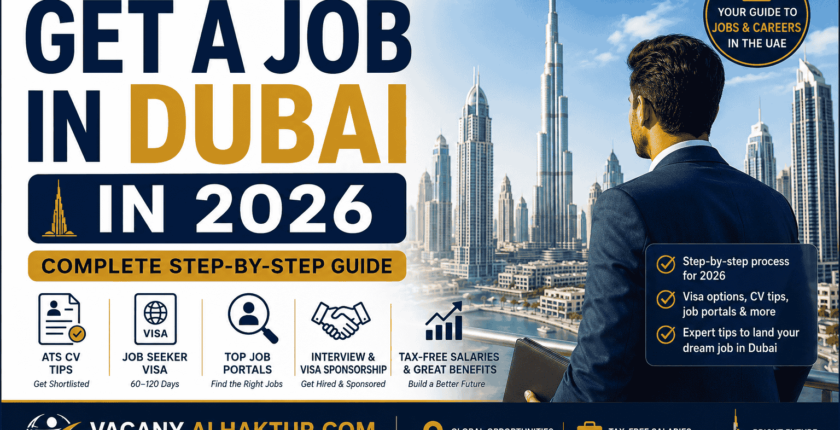
How to Get a Job in Dubai in 2026: A Complete Guide
Quick Answer: To get a job in Dubai in 2026: prepare an ATS-optimised UAE CV, apply via LinkedIn and Bayt, obtain a Job Seeker Visa if applying from abroad (60–120 days), attend interviews, and receive employer visa sponsorship through MOHRE. Tax-free salaries and zero income tax make Dubai one of the world’s most sought-after job markets.
Dubai remains one of the world’s top destinations for job seekers — offering zero income tax, world-class infrastructure, and a thriving economy that spans technology, finance, healthcare, construction, and hospitality. But the market is more competitive than ever.
According to a 2026 LinkedIn survey, 72% of UAE professionals are actively looking for new roles — yet 65% say the job search has become harder over the past 12 months. Getting hired requires the right strategy, not just the right qualifications.
This guide covers every step — from understanding the 2026 job market, preparing your CV for ATS systems, using the Job Seeker Visa, to converting an offer into a UAE residence visa.
1. Understand the Dubai Job Market in 2026
| 48% of UAE companies plan to increase headcount in 2026 (Cooper Fitch Salary Report 2025) |
Dubai’s economy is diversifying under the UAE Vision 2031 plan. The sectors with the strongest hiring activity in 2026 are:
- Technology & AI — AI/ML engineers, cybersecurity specialists (CISSP/CISM-certified), cloud architects, and DevOps professionals. Salaries range from AED 25,000–80,000/month.
- Finance & Banking — DIFC and ADGM-based roles in wealth management, compliance, fintech. AED 30,000–80,000/month for experienced professionals.
- Healthcare — Doctors, specialists, and nurses remain in high demand with DHA/DOH licensing required.
- Construction & Real Estate — Multiple mega-projects running through 2030 need MEP engineers, QS professionals, BIM modellers, and HSE managers.
- Hospitality & Tourism — Driven by Expo City Dubai and a record-breaking tourism pipeline.
Market reality: Entry-level generalist roles and basic admin positions are flat or highly competitive in 2026. Specialist skills in the sectors above are where wage growth of 4–6% is occurring (Cooper Fitch 2026).
2. Use the UAE Job Seeker Visa (If Applying from Abroad)
One of the biggest advantages available to international candidates in 2026 is the UAE Job Seeker Visa — also called the Job Exploration Entry Permit. This allows you to enter the UAE without a job offer, attend interviews in person, and convert to a work visa once hired.
Job Seeker Visa Key Facts
- Duration: 60, 90, or 120 days (single-entry permit)
- Who qualifies: MOHRE Skill Levels 1–3 (managers, professionals, technicians) OR recent graduates from a top-500 global university
- Apply through: ICP Smart Services (all emirates) or GDRFA (Dubai-specific)
- Processing: Fully digital — no in-person visit required
- Documents needed: Valid passport (6+ months), attested degree certificate, CV, passport photo, proof of financial stability
Critical note: Unattested paperwork is the most common reason Job Seeker Visa applications are rejected or delayed. Get your degree attested through your home country’s Ministry of Education and UAE MOFA before applying — this takes 4–8 weeks.
Being physically present in Dubai accelerates hiring significantly. UAE employers strongly prefer in-country candidates — face-to-face meetings are a cultural expectation in UAE business culture.
3. Prepare an ATS-Optimised UAE CV
Most large UAE employers — multinational corporations, banks, government entities, and healthcare groups — now use Applicant Tracking Systems (ATS) such as Workday, SAP SuccessFactors, or Oracle Taleo. Your CV is screened by software before any human reads it.
ATS CV Rules for Dubai 2026
- Use a single-column layout — two-column CVs are not readable by most ATS
- Use standard fonts: Arial, Calibri, or Times New Roman at size 11–12
- Save as PDF (unless the employer specifies Word format)
- Use the exact job title from the posting as a keyword in your CV
- No graphics, tables, or text boxes — ATS cannot extract text from these
- The professional summary and skills section are where ATS scores are won or lost — tailor them for every application
Pro tip: The top third of your CV — name, summary, and skills — gets the most weight in ATS scoring AND the most attention from recruiters. Tailor this section specifically for every application, not just the job title.
UAE-Specific CV Requirements
- Include nationality and current visa status — employers need this for quota and sponsorship planning
- Add a professional headshot (white background) — expected in most UAE applications
- Include date of birth — standard in the UAE market
- State current and expected salary in AED/month
- Length: 2–3 pages for mid-level; 1–2 for fresh graduates; up to 4 for senior/director roles
4. Where to Search for Dubai Jobs in 2026
The UAE has a mature digital jobs ecosystem. Use a combination of these platforms:
- LinkedIn — Essential for professional and corporate roles. Most recruiters in the UAE actively source from LinkedIn in 2026.
- Bayt.com — The GCC’s largest job board with 4,450+ active Dubai listings. Strong for mid-level professionals.
- GulfTalent — Best for senior and specialist roles across the Gulf.
- Naukrigulf.com — Popular among South Asian professionals; strong in construction, logistics, and IT.
- vacancy.alhaktur.com — UAE-focused job board with verified listings updated regularly. Covers all sectors and emirates.
- Company career pages — Especially for ADNOC, Emirates Group, EMAAR, FAB, Majid Al Futtaim, and major tech firms.
Walk-in interviews: Extremely common in Dubai for hospitality, retail, logistics, and security roles. Follow company social media pages and job portals for walk-in dates. See our complete walk-in interview guide for tips.
5. The Dubai Interview Process in 2026
Dubai employers in 2026 run structured, competency-based interviews. They want specific examples with numbers — not general claims about your skills.
Typical Interview Rounds
- HR screening call (30 min) — culture fit, visa status, salary expectations, notice period
- Technical/panel interview with line manager — STAR-format competency questions
- Final interview with department head or country manager — strategic fit, package discussion
What Dubai Interviewers Always Ask
- Are you currently in the UAE or applying from abroad?
- What is your current and expected salary? (Quote in AED/month — include housing allowance expectations)
- What is your notice period / when can you join?
- What is your current visa status? (employment, visit, cancelled, Job Seeker Visa)
- Do you have a UAE driving licence?
Salary tip: Always research the market rate before your interview. Quote a specific AED range — not ‘negotiable’ or ‘open’. Vague answers signal a lack of market awareness to UAE recruiters.
6. Dubai Salary Benchmarks 2026
| AED 0 Income tax in the UAE — your full salary is take-home pay |
UAE salary packages consist of: basic salary + housing allowance (typically 20–25% of basic) + transport allowance + annual return flights home. Always negotiate the full package.
- Entry-level roles: AED 3,000 – 6,000/month
- Mid-level professionals: AED 8,000 – 18,000/month
- Senior managers: AED 20,000 – 40,000/month
- Director / C-suite: AED 50,000+/month
- Tech specialists (AI/ML, cybersecurity): AED 25,000 – 80,000/month
- Finance professionals (DIFC/ADGM): AED 30,000 – 80,000/month
7. Converting Your Job Offer to a UAE Work Visa
Once you receive a job offer, your employer sponsors your residence visa through MOHRE (mainland) or the relevant free zone authority. The process:
- Sign the offer letter and employment contract (MOHRE-attested)
- Employer submits work permit application to MOHRE
- You enter the UAE on a visit visa or employment entry permit
- Medical fitness test in UAE (HIV, TB, Hepatitis B&C, Leprosy, Syphilis — foreign medical reports are not accepted)
- Emirates ID biometrics and registration
- Residence visa stamped in passport — valid 2 years, renewable
Golden & Green Visa: Since 2023, the UAE offers self-sponsored visas for high earners and skilled professionals. If you earn over AED 30,000/month or hold certain qualifications, you may be eligible for a 5-year Green Visa or 10-year Golden Visa after 2 years in the UAE.
8. Mainland vs Free Zone Jobs — Key Difference
This is something most job guides skip but it directly affects your employment rights and visa:
- Mainland companies are regulated by MOHRE — standard UAE Labour Law applies, including gratuity, annual leave, and end-of-service benefits
- Free zone companies (DIFC, Dubai Internet City, JAFZA, etc.) have their own employment regulations and visa authorities — terms can differ significantly
- Free zone employees generally cannot work outside their free zone without a mainland permit — check this if you are considering client-facing roles
Key question to ask: Always confirm in your offer letter whether the company is a mainland LLC or a free zone entity — this affects your visa sponsor, labour law protections, and future job mobility.
Ready to Start Your Dubai Job Search?
The Dubai job market in 2026 rewards prepared candidates. With the right CV, the correct visa strategy, and a targeted approach to the sectors that are actively hiring, your chances of landing a role are strong.
Browse verified UAE job listings at vacancy.alhaktur.com/job-listings/ — updated regularly across all sectors and emirates.
Related guides on this site: